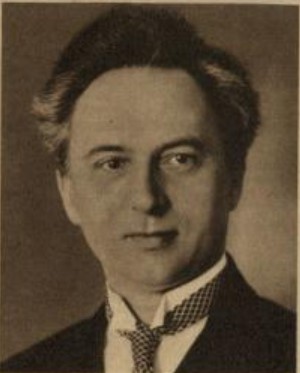
Arthur Johannes Scholz (1883-1945)
This project focuses on the rediscovery of the Austrian composer Arthur Johannes Scholz (1883-1945). It aims to help bridge a significant gap that persists in the guitar and chamber music literature within the Mitteleuropean landscape of the first half of the 20th century. To this day, his music remains largely unpublished and lacks modern recordings; this research seeks to restore it to the active repertoire, bringing to light forgotten pages of Viennese and 20th-century guitar literature that have remained in obscurity for nearly a century.
The project has its roots in Turin, originating from the research of Dora Filippone and the Guitare Actuelle team. It continues today in Switzerland as an artistic research project by Marcello Massari, with the support of Prof. Elena Càsoli and Dr. Nathalie Meidhof, focusing on archival research, artistic practice, first modern performances, and critical editions.
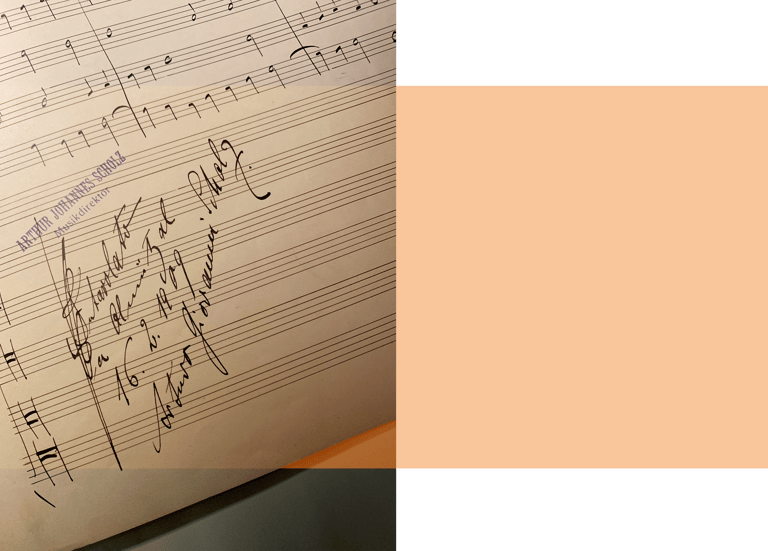
Critical Revision and Edition
Study and modern critical revision of original manuscripts, featuring the publication of Arthur Johannes Scholz's works with guitar by Pizzicato Verlag Helvetia.
Record Production
Recording of a first monographic volume dedicated to Scholz, the result of extensive research into the rediscovery and performance of previously unreleased works (forthcoming on the Da Vinci Publishing label).
series in progress
published
Biographical notes on Arthur Johannes Scholz
Arthur Johannes Scholz (born 16 November 1883 in Lemberg — today Lviv, Ukraine; died 3 April 1945 in Vienna) represents an almost entirely forgotten figure within the Austrian musical landscape of the first half of the twentieth century.
Scholz received his musical education in Goldberg (today Złotoryja, Poland) and Vienna. Subsequently, he worked as an organist, conductor, and choral and orchestral director across Spalato (today Split, Croatia), Olmütz (today Olomouc, Czech Republic), and Vienna, where he settled permanently in 1911.
A versatile instrumentalist by training — violin, oboe, flute, clarinet, piano and organ — he dedicated his entire artistic career to composition and choral conducting, with an extensive œuvre including operas, symphonies, and choral works. Nevertheless, the core of his artistic legacy lies in his chamber music, which is characterized by its remarkable originality. In the final years of his life, he focused particularly on compositions for guitar, both for solo and chamber music ensembles, an instrument he had always regarded as especially rich in expressive possibilities. In this context, he collaborated closely with the Viennese guitarists Gerta Hammerschmid (1906–1985) and Luise Walker (1910–1998), to whom he dedicated works of great refinement and expressive power. Scholz was also a colleague of Luise Walker at the Staatsakademie für Musik und darstellende Kunst in Vienna (today the University of Music and Performing Arts Vienna). Starting in 1932, he held there the position of lecturer for the Akademische Chorschule and Praktische Instrumentation. Available archival documents indicate that from 19 February 1933 he was an illegal member of the Nationalsozialistische Deutsche Arbeiterpartei (NSDAP), which was banned in Austria starting in June of the same year. From 1937, he held the chair of Melodiebildungslehre.
Scholz won several prizes in Austria, Spain, Germany, and Switzerland, and his musical career in Vienna as a composer and conductor was marked by significant collaborations — notably with the Wiener Symphoniker — and several successes, such as the comic opera Don Diego, for which he also authored the libretto. His public concert career, however, ceased abruptly; indeed, the last documented official performance of one of his works took place on 13 April 1937, when the Wiener Symphoniker performed his composition for male choir and orchestra, Die Mühle am Arendsee. Following this event, his compositions largely disappeared from public concert repertoire.
With his wife, Charlotte Scholz (1888–1961), he had a son, Klaus (1915–1992), an engineer recognized today as one of the pioneers of robotics in Austria. Following his death on 3 April 1945, Arthur Johannes Scholz quickly faded into obscurity. Many of his works, often conceived for large ensembles, remained unpublished.
Author
Marcello Massari
Last updated
26.04.2026
Literatur
Personnel file of Arthur Johannes Scholz. Archive of University of Music and Performing Arts Vienna (Archive der mdw).
Karoline Hochstöger, "Scholz, Arthur (Artur) Johannes", in Oesterreichisches Musiklexikon online, founded by Rudopf Flotzinger, edited by Barbara Boisits; last accessed 28.02.2026.
Josef Haubenberger, "Die Tondichter Arthur Johannes Scholz und Kurt von Tenner”, in Radio Wien, 11 October 1935, pp. 2-3; last accessed 23.02.2026.
Luise Walker, "Arthur Johannes Scholz", preface to "Sonate e-moll", by Arthur Johannes Scholz. Vienna, Musikverlag V. Hladky, 1947 (V.H. 1504).